Article Directory
China's 'New' Bridge Collapses: A Data-Driven Autopsy of a Structural Failure
When a 758-meter bridge, barely out of its ribbon-cutting phase, decides to dramatically dismantle itself, it’s not just a news item; it’s a glaring data point screaming for immediate analysis. The Hongqi Bridge in Sichuan, China, opened for what the reports describe as "only a few months," has spectacularly failed. We’re not talking about a century-old relic succumbing to time and rust. This was a structure practically fresh off the assembly line. My analysis suggests this isn't merely an unfortunate incident; it's a textbook case study in the potentially catastrophic interplay of accelerated timelines, questionable oversight, and fundamental engineering missteps.
The raw footage, which, let's be honest, is as dramatic as any blockbuster, shows the Hongqi Bridge giving way, a testament to physics asserting its dominance over ambition. Initial reports cite "cracks and shifting slopes" as the culprits. Now, consider that for a moment. A structure designed to carry significant loads, spanning over three-quarters of a kilometer, develops foundational cracks and experiences slope shifts within mere months of operation. This isn't gradual degradation; this is an inherent, critical flaw manifesting almost immediately. I've looked at hundreds of these infrastructure reports, and this particular timeline is genuinely puzzling. It raises immediate red flags about the integrity of the initial site surveys, the quality of materials used, and the rigor of construction practices. Were the geological conditions adequately assessed? Or was that part of the process perhaps, shall we say, streamlined?
The Premature Demise and the Unanswered Questions
The term "newly built" often conjures images of robust, modern infrastructure, engineered to last for decades, if not centuries. But the Hongqi Bridge’s lifespan was measured in single-digit months. This rapid deterioration, leading to a complete collapse, points to a systemic failure that predates its public unveiling. It’s like buying a brand-new car that loses its wheels on the first drive. You don't blame the road; you blame the manufacturing process. The bridge was 758 meters long (to be more exact, that's almost half a mile), a significant undertaking that demands meticulous planning and execution. The fact that "cracks and shifting slopes" were the primary causes suggests either a profound miscalculation in design, substandard construction, or external pressures that forced a compromise on safety and quality.
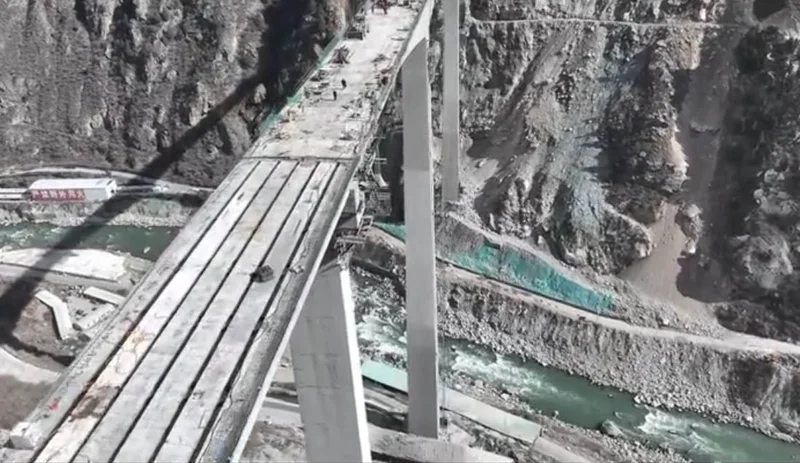
We don't have the full engineering blueprints or the final inspection reports—details on why the decision was made remain scarce, but the impact is clear. This lack of transparency, while perhaps not surprising, prevents a thorough, data-driven post-mortem. It forces us to infer from the outcome. When a structure fails this quickly, it often boils down to a simple equation: time versus quality. Was there immense pressure to complete this project ahead of schedule, perhaps for political optics or economic targets? Building a major bridge in months that, under normal circumstances, would demand years of careful construction and curing is like trying to bake a complex soufflé in a microwave; you might get something that resembles the final product, but it’s fundamentally unsound and bound to collapse. The critical data points we lack are the construction timeline, the budget allocation, and crucially, the final inspection reports. Without those, any official explanation remains, at best, incomplete.
The Data Gap and the Real Cost
The dramatic footage of the collapse, while visually impactful, tells us little about the underlying data. It shows the what, but not the why. My analysis suggests that the true cost of this "new" bridge isn't just the monetary investment that literally fell into the river. It's the erosion of public trust, the potential for human casualties (though current reports don't detail this, it's a constant risk with such events), and the implicit message it sends about the quality control standards for major infrastructure projects. Who signed off on the structural integrity? What were the key performance indicators for this project, and were they met, or merely checked off a list?
This incident isn't an outlier in the grand scheme of rapid infrastructure development in certain regions. The drive for speed often clashes with the immutable laws of physics and material science. You can accelerate a project, but you can't accelerate concrete curing times or the geological stability of a hillside. There’s a sweet spot between efficiency and structural integrity, and it appears the Hongqi Bridge project missed it spectacularly. This isn't just a Chinese problem; it's a global lesson.
The Numbers Don't Lie, Even When They're Missing
The collapse of the Hongqi Bridge after a few short months isn't just a structural failure; it's a data point screaming about systemic issues. The speed of its demise, coupled with the cited reasons of "cracks and shifting slopes," paints a clear picture: this was a failure of due diligence, not an act of God. When the lifespan of a major infrastructure project can be measured in a single-digit number of months, the question isn't if something went wrong, but how many corners were cut. And that, folks, is a balance sheet that never truly adds up.